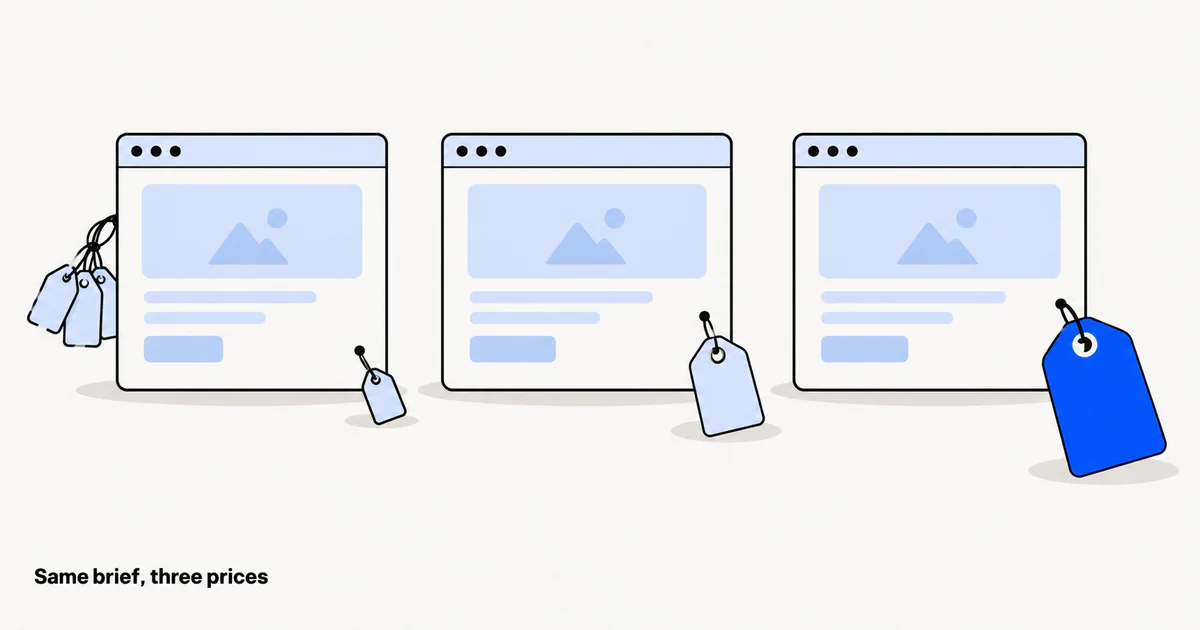
Nobody wants to ask the price first, so most people ask it last, after four meetings. Ask it first. A vendor who can't give you a range before the discovery call is either guessing or waiting to find out what you'll pay.
Here is the range we see in India, what sits behind each number, and the part of a quote that decides everything.
Why one brief gets quoted at ₹10,000 and at ₹4 lakh
Both quotes can be honest. They are for two different things wearing the same word.
"Website" covers a template someone fills in over a weekend, and it covers a platform with a payment gateway, a stock feed and a staff login behind it. The brief you sent was probably a paragraph. Each vendor filled in the missing ninety percent from experience, and they filled it in differently. So the first job isn't comparing prices. It's getting everyone to quote the same thing.
The bands, roughly
Prices move, and anyone handing you a fixed table is selling from it. Treat these as the shape of the market rather than a rate card.
- Under ₹15,000 — a template, filled in. Enough for a first presence: who you are, what you do, how to reach you
- ₹25,000 to ₹75,000 — a real small business site. Layout drawn for you, a page for each service, structured data, sensible speed
- ₹1,00,000 to ₹3,00,000 — a site built around a goal, where content and structure are planned for search and enquiries rather than decided page by page
- ₹3,00,000 and up — commerce with genuine catalogue logic, or a site with software behind it: logins, bookings, dashboards, integrations
Most businesses that arrive convinced they need the fourth band need the second one done properly, with the difference spent on photography and words. That is almost always the better trade.
Pages don't set the price
The most common way a quote goes wrong is pricing by page count. Twenty near-identical product pages are cheap. One booking flow that checks availability, takes a payment and sends a confirmation is not, and it is one page.
What actually moves the number:
- Whether the design is drawn for you or bought and adjusted
- Who writes the words, and who takes the photographs
- Each integration: payments, WhatsApp, CRM, accounting, courier, every one with its own edge cases and its own way of failing
- Whether anything needs a login, and whether different people see different things
- A second language done properly, rather than a translate widget
- How much of it your team has to be able to change without calling anyone
The costs that aren't in the quote
The build is a one-off. The site isn't.
- Domain and hosting, small but annual, and the renewal is always dearer than the first year
- Payment gateway charges on every transaction, plus settlement timing worth checking before you pick one
- Photography and content, the line most people cut and most regret cutting
- Maintenance: updates, backups, and the contact form that quietly stopped sending mail three weeks ago
- Changes, because the business will change
Ask for the annual figure, not the build figure. A ₹60,000 site with ₹4,000 a year behind it and a ₹60,000 site with ₹40,000 a year behind it are different purchases.
Why the cheap one often isn't
The ₹8,000 site is a real product and sometimes the correct purchase. It stops being cheap when it is sold as the other thing.
The rescue jobs we get asked about look the same every time. Nobody can edit it without calling the person who built it. The enquiry form has been failing silently for months. There is no page for the service people actually search for. It takes eleven seconds to load on a mid-range Android because the header image is a 6 MB JPEG. Rebuilding that costs more than building it once, because you pay twice and lose the year in between.
The opposite mistake is just as expensive and gets far less sympathy: ₹5 lakh on a beautiful site for a business whose actual problem was that nobody could find it.
Six questions that sort the quotes
Send these to everyone who quotes. The answers separate people faster than the prices do.
- What exactly is included, and what is the first thing that becomes extra?
- Who writes the content, and is that inside this number?
- What does it cost me every year after launch, all in?
- Can my team change text and images without you?
- If we stop working together, do I own the code, the domain and the hosting account?
- Show me something you built two years ago that is still running.
The last one is the most useful. Anyone can show you a launch. Not everyone can show you something that survived.
What to spend on first
When the budget is smaller than the ambition, and it usually is, this order returns the most:
- Real photographs of your work, your premises and your team
- Words that name the customer's problem in the customer's language
- A page for every service and every location you want to be found for
- Speed on a mid-range phone over mobile data, because that is the actual device
- One low-commitment way to make contact, WhatsApp included
- Design, last, sitting on top of all of it
That order irritates people who came to buy a design. It is also why a ₹80,000 site built in this sequence sometimes out-earns the ₹3 lakh one across the road.