Nearly every business we work with runs on spreadsheets, and we rarely suggest getting rid of them. Excel is the most successful business software ever written, because it does one thing no custom system does: it changes shape the moment your process does, with nobody's permission and no developer.
The spreadsheet isn't the problem. The problem is the day it stopped being a tool and became the system of record, which nobody announced and nobody wrote down.
How it happens
It always starts reasonably. One file for orders. Then a second, because dispatch needed different columns. Then a WhatsApp group where the two get reconciled each evening. Then a third file whose only job is to copy numbers out of the first two so somebody can see a total. Nobody decided any of this. It accumulated one sensible step at a time, and every step was cheaper than the alternative on the day it was taken.
The signs you have crossed the line
You don't need all of these. Three is plenty.
- One person understands the file, and the business genuinely stalls when they take leave
- Someone spends the first hour of every day making two files agree with each other
- The same information is typed twice: once in WhatsApp, once in the sheet, sometimes again in Tally
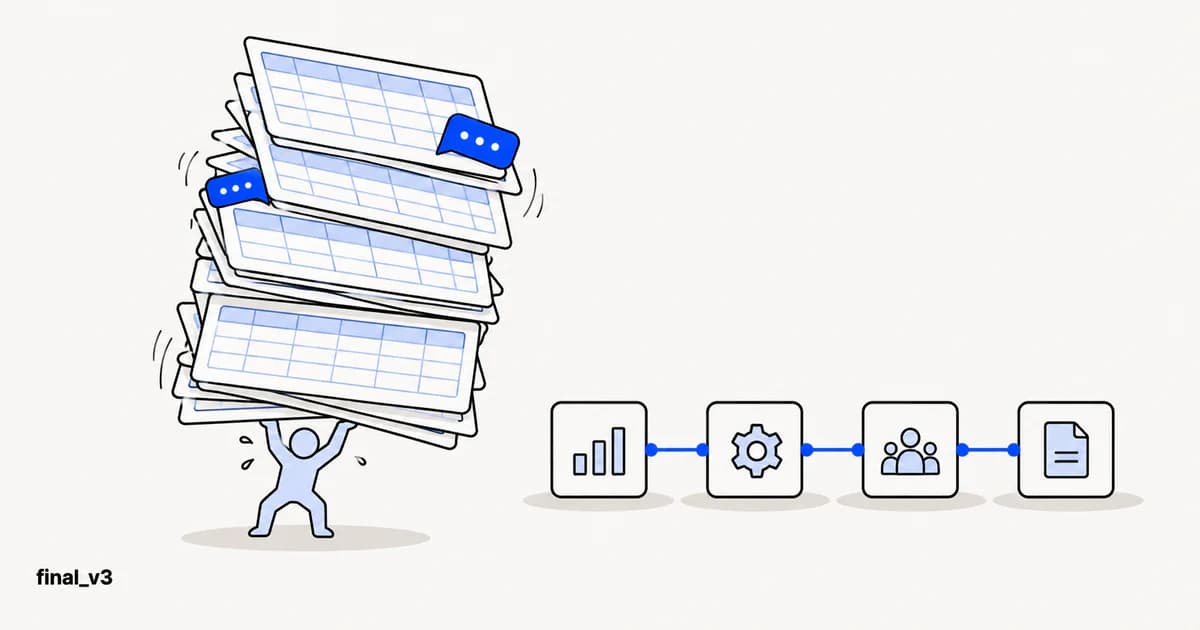
- There are files called final, final2 and final_updated, and which one is real is settled by asking
- A simple question, like how much went out last month or what is still unpaid, needs a person and an afternoon
- You have started avoiding a change to how you work because updating the sheets would be worse than the change
The last one is the expensive one. Once the tooling decides what the business is allowed to do, the cost has stopped being hours.
What it is actually costing
Add it up honestly before deciding anything. Two hours a day of reconciliation against a ₹30,000 salary is roughly ₹90,000 a year of somebody's time, and that is the small number.
The big ones are the order that shipped twice, the payment nobody chased for four months, the stock figure that was wrong on the day a serious customer asked, and the fact that if one laptop dies the business loses its memory. None of those appear on a monthly cost line, which is exactly why they run for years.
Three ways this goes wrong
- Buying a large ERP because somebody demonstrated it well. Most of it is never switched on, and the spreadsheets keep running alongside it
- Rebuilding the spreadsheet exactly as software. You would be paying to make your workarounds permanent, including the ones that only exist because a sheet can't do what a database does easily
- Replacing everything at once. The changeover is where these projects die, because the business still has to run while it happens
Buy it, unless the process is yours
If what you need is accounting, payroll or GST filing, buy it. Those processes are defined by law and convention, thousands of businesses do them identically, and there is mature Indian software for all of it at a price nobody can build against.
Build when the process is the thing that makes you different. The job-card flow only your workshop uses. A pricing rule your competitors don't have. A dispatch sequence shaped around how your area actually works in July. Nobody sells that, because nobody else needs it in that shape.
Most businesses need some of each, joined together properly. Joining them is the part that gets skipped, and it is the part that decides whether anyone uses the result.
Build the smallest useful thing
The version of this that works is boring. Take the worst hour in the week and remove it. One screen, one process, live in three weeks, used by the people who were doing it by hand.
Then the next one. You get value while you are still paying, the team learns the system in pieces instead of in a training session, and you find out early whether the process everyone described is the process that actually happens. It never quite is.
A realistic order of work
- Write down what really happens, including the steps nobody admits to, before anyone designs anything
- Find the step that gets typed twice and kill the second one
- Put the data somewhere shared, with one version and a record of who changed what
- Automate what has a clear trigger: order confirmed, payment received, stock below level
- Give each role the view it needs, so the question gets answered without a person
- Leave the spreadsheet in place for what it is genuinely better at, and stop treating that as a failure
Done in that order, most businesses stop noticing the system within a quarter. That is the goal. Software you have to think about is software still in your way.